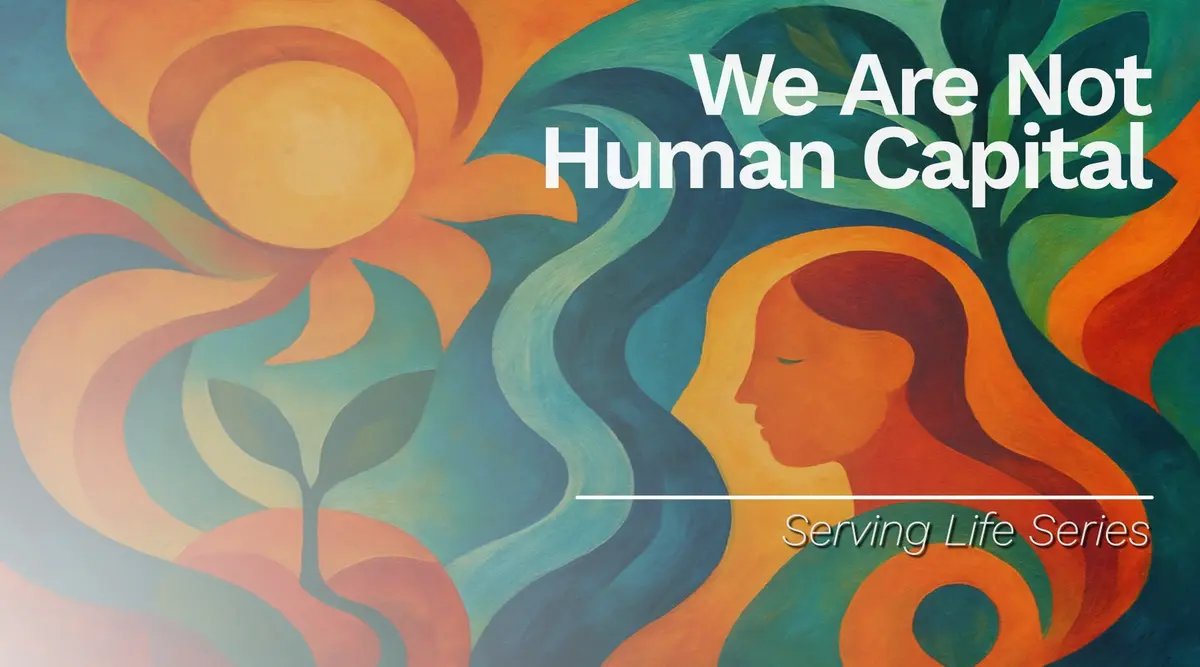
In the first article of this Serving Life series, we saw how life as a whole is framed as a resource. That flip doesn’t stop with so-called nature — it turns back on ourselves. Across workplaces, organizations, and economies, people are no longer simply people. They are “assets,” “headcount,” and “cost centers.” Entire departments are named Human Resources, as if the living beings who show up each day were supplies to be allocated.
Our Daily Lens
“We need to hire more headcount.”
“Our people are our greatest asset.”
“Human capital is our most important investment.”
“We’re headhunting for top talent.”
These phrases roll off the tongue. But each carries a quiet distortion: the translation of human life into units of value. Even the term headhunting makes the reduction plain — people treated not as whole beings but as heads to be counted, hunted, and acquired.
Story Lens: Humans as Assets, Costs, Capital
Through the Story Lens, this language makes sense. Organizations run on budgets and balance sheets. People are reframed as productivity, talent pools, or liabilities. In this lens, the worth of a human being is tethered to the output they produce and the costs they incur.
It’s important to note that terms like “human capital” first emerged to highlight that people are central to organizational success — to stress their importance in business terms. Yet over time, the framing narrowed, reducing people into means for another end: the performance of the company, the goals of the career ladder, the abstractions of GDP growth.
Life Lens: People as Unique Flows of Being and Contribution
Through the Life Lens, something else comes into view. Each person is not capital but a unique flow of being, alive with relationships, creativity, and contribution. Work, seen this way, is not about extracting performance but about cultivating the conditions where life can flourish through shared contribution.
To call people “resources” is to forget that every human being is both irreplaceable and interconnected, not assets to be consumed, but participants in life’s continuous unfolding.
Flip the Lens in Practice
The dissonance you feel when hearing “headcount” or “human resources” is not confusion — it is life rebelling against the fiction. And that rebellion becomes real when it’s voiced. Try this:
Call it out.
When you hear “headcount” or “human capital,” pause and ask: Is that how we want to see people? Even a gentle question plants a seed.Replace it out loud.
Instead of silently swapping “headcount” for “contributors” in your mind, say it. “We need two more contributors on this project.” Words spoken in the open shift what feels obvious.Ask the human question.
When someone is called a “resource,” ask: Whose life is touched here? How do they flourish in this role?Invite reflection.
In meetings or planning sessions, introduce one moment where people step back from metrics and ask: What human realities sit behind these numbers?
Every time the language of capital is questioned aloud, the Story Lens loses ground — and the Life Lens begins to reshape the culture we share.
From Capital to Contribution
The flip we inherited casts people as capital, as headcount to be managed, even “hunted.” The flip we need is to recognize people as life in motion, each one irreplaceable, each one carrying gifts for the whole. If we keep designing workplaces around efficiency alone, we will keep draining the very life they are. But if we flip the lens back, work stops being about managing assets and starts being about serving life.
The question is no longer how much can we get from people, but what becomes possible when people are free to bring their full life into the work we share. This isn’t about discarding accountability or performance; it’s about remembering that performance without people’s full life behind it is hollow.